Email:
[email protected]
[email protected]
WhatsApp:
(233)-203-626-065
(233)-203-626-065
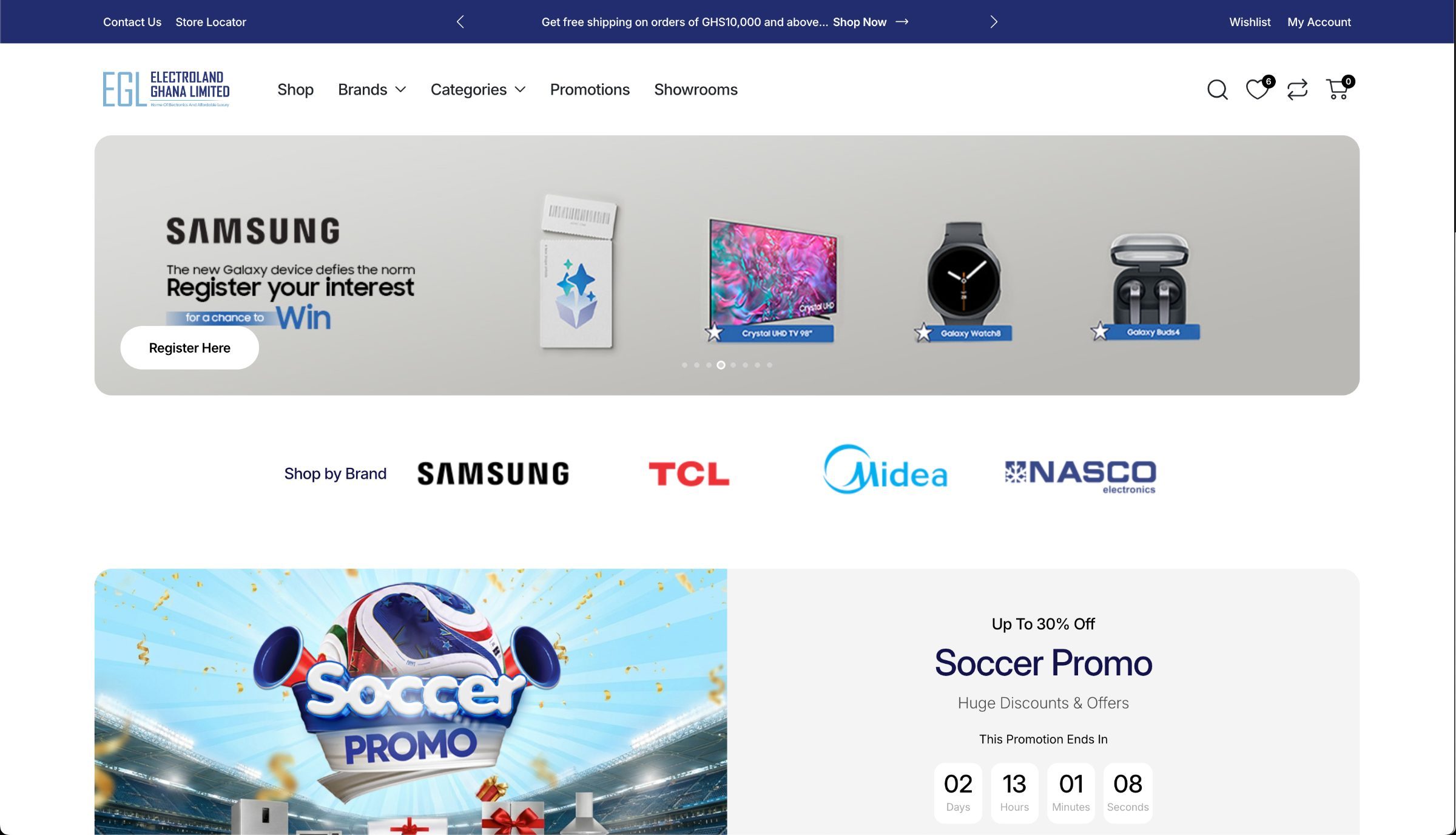
Electroland Ghana sells televisions, air conditioners, refrigerators, laundry and kitchen appliances, mobile phones and audio equipment as the self-described "home of electronics and affordable luxury". They came to us with an existing site that was slow, unresponsive on mobile, and difficult to navigate — built on markup and code that had become an obstacle to the business rather than an asset.
The brief was a rebuild: a storefront that could carry a catalogue of over 2,000 products across eight categories, connect to 19 physical showrooms, and be maintained by their own team.
The existing site had accumulated the problems that make a retail platform quietly expensive. Pages were slow. The layout did not adapt properly to mobile, where a large share of Ghanaian shoppers browse. Navigation did not lead customers to products, and the underlying markup made every fix harder than it should have been. Rebuilding was the cheaper option.
Scale made the merchandising a first-order problem. Over 2,000 products is well past the point where a customer can browse casually — televisions alone span UHD, LED, OLED, QLED and Mini LED, and refrigerators come in single-door, side-by-side, French door and freezer configurations. Without filtering that reaches a specific product quickly, catalogue breadth becomes a liability.
Payments carried their own constraint. Card penetration in Ghana is limited, and a checkout built around cards alone excludes a large share of genuine buyers. Mobile Money is how much of the market actually pays.
The store also could not exist in isolation from the physical business — with 19 showrooms, customers routinely research online and buy in person, and the site had to support that path rather than fight it.
We built the storefront on WordPress and WooCommerce with a custom theme, structuring the catalogue across eight top-level categories with configuration-level filtering beneath each. WooCommerce was the right foundation here precisely because it is well-trodden: Electroland's own staff can manage products without developer involvement.
Checkout integrates Ghanaian Mobile Money networks alongside conventional payment methods, so customers pay the way they already pay. Supporting commerce features — wishlists, promotional codes, a free-delivery threshold, and a 30-day returns workflow — were configured as part of the build rather than bolted on later.
A store locator ties the online catalogue back to physical showrooms, supporting the research-online, buy-in-store journey that a considered purchase like an air conditioner usually follows.
WordPress · WooCommerce · PHP · Mobile Money · MySQL
The rebuild replaced a slow, hard-to-navigate site with a storefront that carries over 2,000 products across eight categories, adapts properly to mobile, and offers payment methods that match how Ghanaian customers actually buy.
Electroland set out expecting an improvement in the range of 20–40%. The rebuild delivered over 250% — not by a marginal tuning of what existed, but because replacing the underlying markup and structure removed the constraints that had been capping performance in the first place.
The other signal is what happened after launch: we maintained the platform for two years. A retail site is never finished — catalogues change, promotions run, payment integrations shift — and a two-year maintenance relationship reflects a platform the business kept building on rather than replacing.